British Pub Food: What to Order in a London Pub
Not sure what to eat in a London pub? Compare pies, Scotch eggs, fish and chips and Sunday roasts, with practical tips for choosing from the menu.

Visiting a London pub for the first time? Learn how ordering at the bar works, what buying a round means and how tipping usually works.
In a London pub, start by finding out where to order. Bar service is common, but don’t spend your visit worrying about a set of secret rules. Look for signs, notice how the room works and ask staff if you’re unsure. A polite “Do we order here?” is more useful than trying to guess.
British pub etiquette is mostly about giving people space, waiting your turn and being clear about what you want. This guide covers a first visit, including rounds and tipping, without assuming every pub handles service in the same way.
Pub company Trust Inns describes ordering at the bar as the usual arrangement in its guide to British pub etiquette.[3] That’s a useful starting point, not a reason to ignore instructions in the pub you’re visiting. Read any signs and check whether the area you’ve entered has its own service arrangements.
If you’re only ordering drinks and can’t see table service, approach the bar and ask. If you’re planning to eat, check how food orders work before settling in. You can say: “Hello, we’re hoping to have lunch. Should we find a table first?” It avoids moving everyone once you’ve made yourselves comfortable.
You don’t need special terminology to ask a question. Let staff explain their system, particularly if different parts of the pub seem to work differently. Finding a free table doesn’t by itself tell you how to place an order or whether a table is reserved.
A busy bar may not have a single-file queue. Trust Inns advises noticing who was there before you and pointing them out if staff turn to you first.[3] Keep track of the people nearby rather than assuming the next person to reach the counter is next to be served.
Read the drinks list while you wait. If you’re ordering for friends, collect their choices before your turn, including sizes. One person can place the order instead of the whole group crowding the counter.
Make eye contact when you can, and wait for staff to acknowledge you. Trust Inns advises against snapping fingers, shouting or waving money to get attention.[3] Once you have your drinks, move away from the serving space so someone else can reach the bar. If you’re unsure who is next, asking is simpler than turning it into a contest.
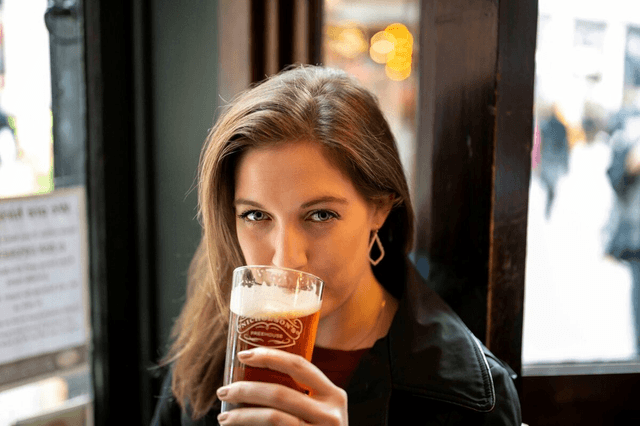
For draught beer, Trust Inns gives “a pint” and “a half” as the usual ordering language.[3] Read the beer’s name and specify the size. For example, you could ask: “A half of [beer name], please.” Replace the bracketed words with the name on the bar or drinks list; this is a sample order, not a claim about any pub’s stock.
If you don’t recognise the choices, describe what you enjoy and ask what staff recommend. “I’d like something less bitter” gives them more to work with than “What is the best beer?” You can also ask what sizes are available before choosing.
If you’re curious about the labels, VisitBritain describes bitter as a type of British pale ale and explains cask beer as beer drawn by gravity or a hand pump.[1] You don’t need to learn the full vocabulary before ordering. Reading the name and asking a short question is enough to begin.
You can choose a soft drink rather than beer. If you want a particular no-alcohol option, ask what is available instead of assuming the pub stocks it. Order for your own preferences, not to match a picture of what a pub visit ought to look like.
Buying a round means one person orders drinks for the group, then another person takes a turn. VisitBritain explains it as a way for one person to buy everyone’s drinks at once, with others buying subsequent rounds.[1]
Before joining in, agree what suits your group. People may have different budgets, be leaving at different times or want different numbers of drinks. Our advice is to say so at the beginning rather than trying to work it out after several orders. Buying your own drink is an alternative if a shared round doesn’t suit you.
Treat rounds as an arrangement between companions, not an obligation to keep drinking until everyone has ordered. Nobody needs to match another person’s pace or choose alcohol to participate in the conversation. This explanation of a social custom is not a tour requirement or a request to buy drinks for a guide.
Expect to pay when you order unless staff explain another arrangement. Trust Inns describes paying for each round as the common approach, rather than automatically running a tab.[3] Have your payment ready and check the amount. If you want to use a tab, ask first instead of assuming the pub will open one.
For tipping, VisitBritain says a tip at the pub isn’t expected and notes that table service may come with a service charge.[1] That means there is no need to calculate a tip on every drink you buy at the bar. It doesn’t mean you should ignore how a food or table-service bill is presented.
Read the bill before adding anything and ask about a charge you don’t understand. If you want to leave a tip, ask staff how to do so. You don’t need to memorise a phrase or offer to buy a member of staff a drink. This is guidance for pub purchases, not a statement about a particular tour’s tipping policy.
For help planning a drinks budget, see our beer-cost guide. Check the actual pub’s prices when choosing your order rather than treating a general guide as its current menu.
Being open for drinks doesn’t answer whether you can order a meal. Ask whether the kitchen is serving and how to place a food order. If you’re planning around lunch, check before travelling rather than assuming you’ll be able to eat whenever the pub is open. VisitBritain notes that some traditional pubs may not serve meals at all.[1]
Near the end of the evening, follow staff instructions about last orders and leaving. Trust Inns describes last orders as a signal to finish the visit.[3] Don’t assume a universal closing hour or a fixed extra period after service ends; ask if you’re unsure what staff mean.
The same approach works throughout a first visit: check this pub’s arrangements, listen to the answer and give yourself time. You don’t have to reproduce every custom you’ve read about online.
If you’d rather explore London’s pub culture with a guide, see historic group-tour availability and read the current tour details before booking. That is the ordinary group-tour booking section, not a private-tour enquiry.
If food is your main interest, read about the separate Pub Food Tour instead. Choose between them by what you want from the visit, and check the current product details rather than assuming both tickets cover the same experience.
Sources checked on 22 November 2026.
Not sure what to eat in a London pub? Compare pies, Scotch eggs, fish and chips and Sunday roasts, with practical tips for choosing from the menu.
From the riverside Dove to the Michelin-starred Harwood Arms, here are the best pubs to visit in London, chosen by the local guides who know them best.
London is home to some of the oldest pubs in the world. A local guide’s pick of the most historic pubs in London, and the stories that make them worth a visit.
If you go to the UK as a tourist, it’s a good idea to try out some of the local beers. As we know, the pint is not just a drink in the UK.